
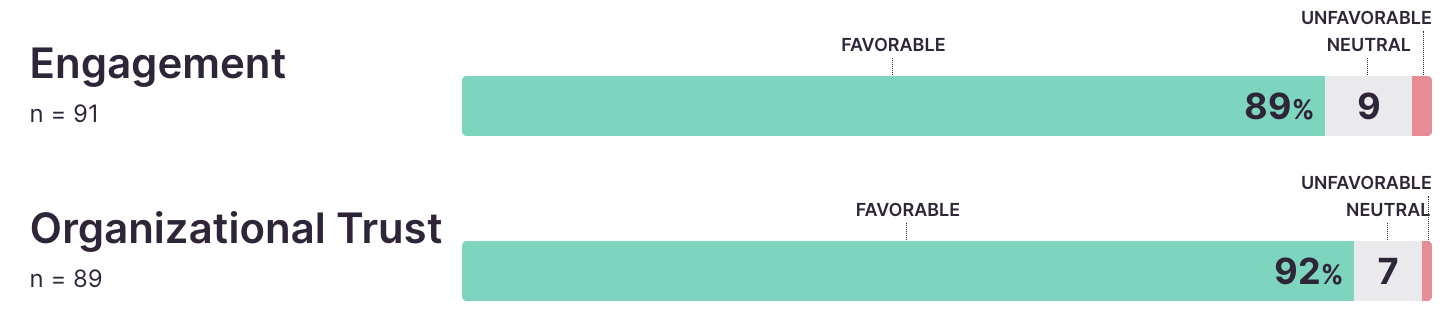
89%
Seven years, nobody left. Then someone did.

I was just back from two weeks of holiday, working through fourteen days of messages. Jetlagged, on autopilot. Flag for follow-up. Archive. Flag. Archive. Archive. The comfortable rhythm of inbox triage, where you can just cruise through everything before diving into deep work again.
Then a Slack message from one of our senior engineers: “I have decided to leave Luscii.”
Fuck.
A sigh and a surprise. For the last seven years, nobody had left the digital health company I co-founded. Well — two people left to try working somewhere else, and both came back after a year. Seven years, net result: zero.
That evening I told my spouse, who also works at Luscii, that I was sad someone was leaving. And I found myself downplaying it: “Nobody has left in seven years. It’s fine.” But a nagging uncertainty lingered. Why was he leaving?
The feeling of uncertainty goes back to my early days as a CTO fifteen years ago. It could take a year to find a good senior software engineer. And people sticking around had become a reassurance that I was doing something right. That people wanted to work at our company. So when someone leaves, it feels personal. Is it me? Is the company changing too much? What did I miss?
The next day, first thing in the morning, I huddled (Slack for video calling) him and congratulated him on his new position. He seemed genuinely sad about leaving. He told me he had received an opportunity he couldn’t say no to. Although that might have been true, I never really felt I got the full story. I still don’t know why he left.
I closed the conversation the way I always close it: “The door is always open, in case you ever want to return.” Those two people who left to try another company? They came back through exactly that door.
Is our culture diluting?
All this made me nervous about our upcoming engagement survey.
For years we have run anonymous surveys twice a year to track how people feel about working at Luscii. The results have always been very high: around 90% engagement, with statements like “I am proud to work for Luscii” consistently scoring 100%. But this time felt different. We had grown the team by 30% to over 100 people in twelve months. We had gotten more embedded in OMRON, our Japanese corporate parent, than ever before. And now someone had left. I was worried our culture was diluting.
89%.
Everyone still proud to work for Luscii. Everyone still recommending it as a great place to work. This time, a sigh of relief.
Maybe part of this is soothing my own insecurity. But I don’t think that’s the whole story. I believe employee engagement is the strongest leading indicator an organization has. Extrinsic motivation gets you through the quarter. But to be extremely good at what you do over many years, you need continuity, people who take ownership, people who go the extra mile because they want the thing to succeed.
Three ingredients
So how do we do this? We didn’t start from a theory. We have been working on this for years, experiment by experiment, keeping what worked and dropping what didn’t. Only later did I notice that where we ended up aligns remarkably well with self-determination theory (fundamental psychological research on intrinsic motivation): mastery, autonomy, and belonging. We didn’t build from the theory; we arrived at it. Which is reassuring.
Mastery, for us, is a four-day work week so people can spend the fifth on their own growth. A yearly personal development budget. Access to coaches. And control over your own set of roles, so you can tune your own challenge. A game that’s too easy is boring; a game you can never win makes you quit. People stay engaged when they get to set their own difficulty.
Autonomy is Holacracy: our way of organizing without managers, where authority lives in roles. Everyone is the CEO of their own roles. Everything that is not explicitly forbidden is allowed by default. And nobody has to be the victim of the organization’s decisions. As long as you stay within our purpose, you can change whatever is needed. Even engagement itself is not owned by HR or any leadership position. We own it together. You want it to change? You change it.
Finally, belonging for us is shaped by purpose and deliberate togetherness. You can only join Luscii if you care about what we’re trying to do in healthcare. And because we have no office (which saves a lot of money), we can invest in social events. These events have rituals like laughing about the fuck-up of the month.
Notice what’s not on the list. We don’t pay the highest salaries. We don’t have lease cars. We don’t give bonuses. People who are engaged and love the purpose accept that trade. It’s not a trick to save money. I believe it’s a reinvestment into four-day weeks, personal growth budgets, social gatherings. And these are more meaningful and powerful than a lease car or a bonus at the end of the year.
What a survey can’t measure
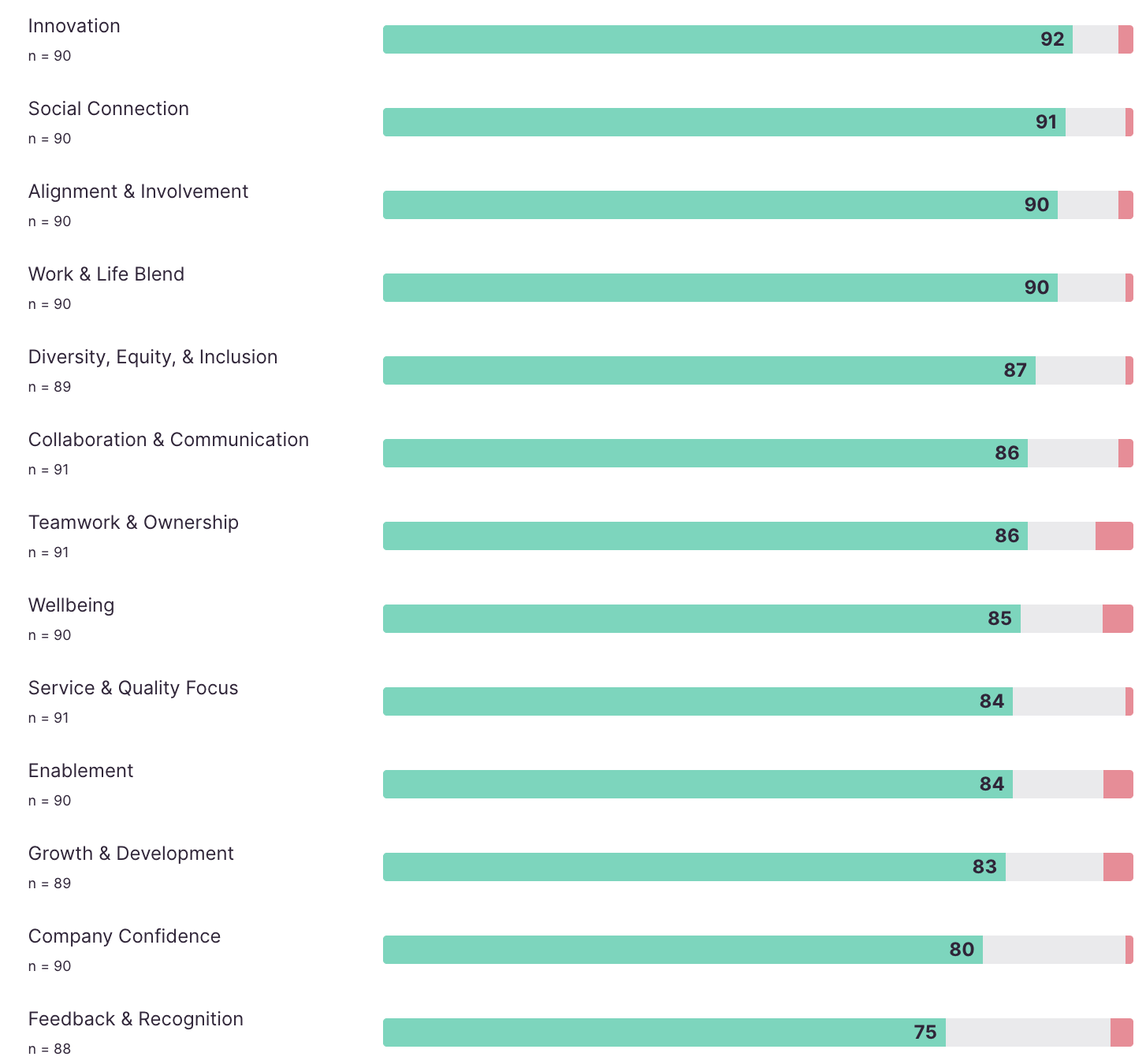
The survey got me a convincing 89% score: the culture was fine. But I still wanted to understand why the engineer was leaving.
In a company where everyone is proud, where engagement is part of the identity, leaving might *need* a socially acceptable story. “An offer I couldn’t refuse” is an exit line that doesn’t indict our culture, or his colleagues, or me. I realize that with our high engagement, speaking the truth on your way out is very hard.
I just hope he also comes back in a year with fresh perspectives. And maybe then, I will learn why he really left.
89% is not 100%.
ps: before sending this out, I shared it with the person who left to check if he is okay with me sharing this story. He told me: “Luscii is the most wonderful place I have ever worked and I already miss the people and culture. Net zero is still possible in a year.”